UPM Communication Papers is introducing a flagship heat-pump project at its Augsburg mill in Germany, with construction scheduled to begin in June 2026. Designed to convert unused excess heat into process steam, the initiative aligns with UPM’s 2030 climate goals and represents a notable technological advancement for the site.
Augsburg paper mill breaks new ground
Today, the area west of UPM Augsburg’s Paper Machine 3 (PM3) looks simple: an undeveloped strip of land within the 23-hectare mill site, untouched and waiting for construction to begin. But for the mill’s engineering team, this corner represents the start of an important technological leap — integrating pioneering heat-pump technology that brings both efficiency gains and a notable reduction in the CO₂ footprint.
“This will be the new home for our heat-pump operating building,” says Markus Rausch, Project Manager at UPM Augsburg, standing on the future construction site. “So far, this part of the area has been unused. Now it becomes the starting point for a system that will convert excess heat directly into process steam.”
For Rausch, this project feels like it is coming full circle. Back in 1999, he was the project engineer for the PM3, one of the world’s most advanced online paper machines. Today, he leads the next big step in its development toward low-carbon production.
Construction of the new building will begin in June 2026, anticipation across the mill is already growing.
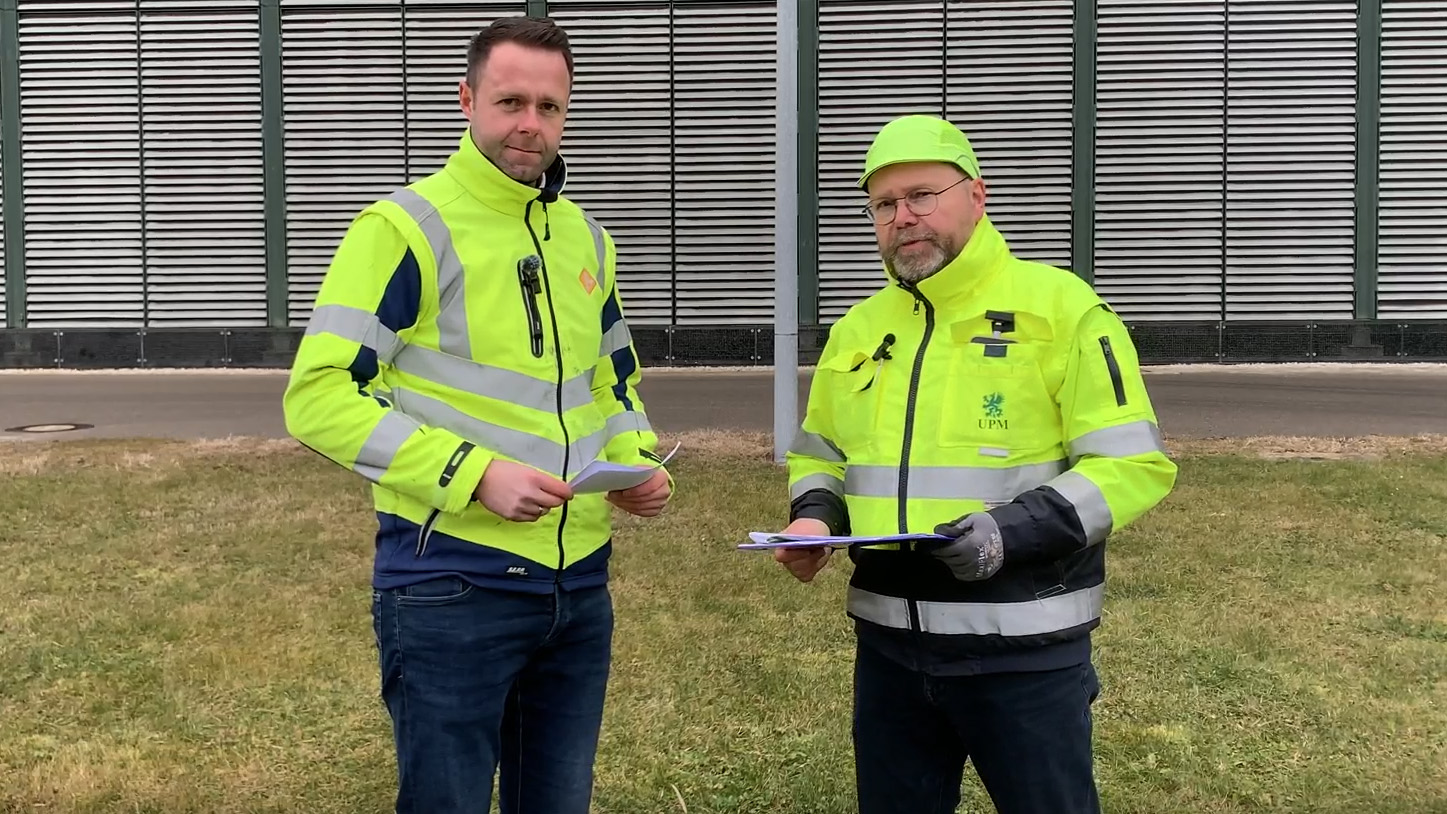 Markus Ladebeck, Director Operations (left), and Markus Rausch, Project Manager (right) at the future site of the new heat pump beside PM3 at UPM’s Augsburg mill.
A first-of-its-kind system in the paper industry
Almost every mill generates excess heat, but only a few are able to both recover it and turn it directly into fresh steam. Over the last years, the Augsburg team has continuously improved PM3’s heat-recovery system. They discovered that a large amount of unused excess heat at around 40–50 °C is still available — an ideal temperature range for supplying the new high-temperature heat pump.
“Exactly this excess heat is what we will now capture,” explains Rausch. “And this location keeps the distances short. It’s right beside the PM3 systems, which the heat pump will integrate with.”
The new system converts excess heat into 8 tons of fresh steam per hour, matching PM3’s required pressure and temperature (3.7 bar and 150 °C). This allows the heat pump to feed the steam straight into the existing system, covering approximately 16% of PM3’s steam demand.
“This is economically attractive, but even more, it’s a flagship initiative,” Rausch says. “And the principle behind it could be implemented on many other paper machines in the future.”
Pioneering technology driving decarbonization
Steam production is one of the most energy-intensive steps in papermaking. With its new heat pump, UPM Augsburg can now generate process steam far more efficiently by using existing heat resources, saving approximately 6,000 tons of fossil CO₂ emissions annually.
“Avoiding 6,000 tons of fossil CO₂ is equivalent to a 14% reduction in emissions from the Augsburg power plant,” says Niina Niemelä, Senior Manager Sustainability. “The new heat pump supports our ongoing efforts to lower fossil CO₂ emissions as outlined in our Climate Action Roadmap. Integrating modern, innovative technologies like this is essential as we work toward our 2030 ambition of reducing emissions to below 100 kg CO₂ per ton of paper.”
The heat pump also uses natural refrigerants, ammonia and water, both with a global warming potential of zero, reinforcing its environmental credentials. The electricity needed to operate the system will come from a dedicated wind Power Purchase Agreement.
The minds and the hands behind the heat pump
“This project shows how modern technologies help us improve our processes,” says Markus Ladebeck, Director Operations at UPM Augsburg. “But above all, it’s a big success for the Augsburg mill and a great achievement by everyone involved. Projects of this scale only work when many teams, from engineering to operations to energy, pull in the same direction. I’m genuinely excited to see the heat pump in action soon.”
“We’re excited to build something that doesn’t just improve our mill but shows what’s possible,” says one team member.
Another adds: “A great contribution to decarbonization and another step toward greater operational flexibility!”
What happens next?
The project is now moving into the engineering phase, with preparatory work already underway. Construction of the new building is planned to begin in summer this year, followed by the installation and integration of the heat-pump system. Initial commissioning is expected shortly after installation is complete, with continuous operation targeted in the first half of 2027.